
From Raw Blank to Finished Component: Navigating the Distinct Machining Requirements of Castings and Forging
5/5/2026
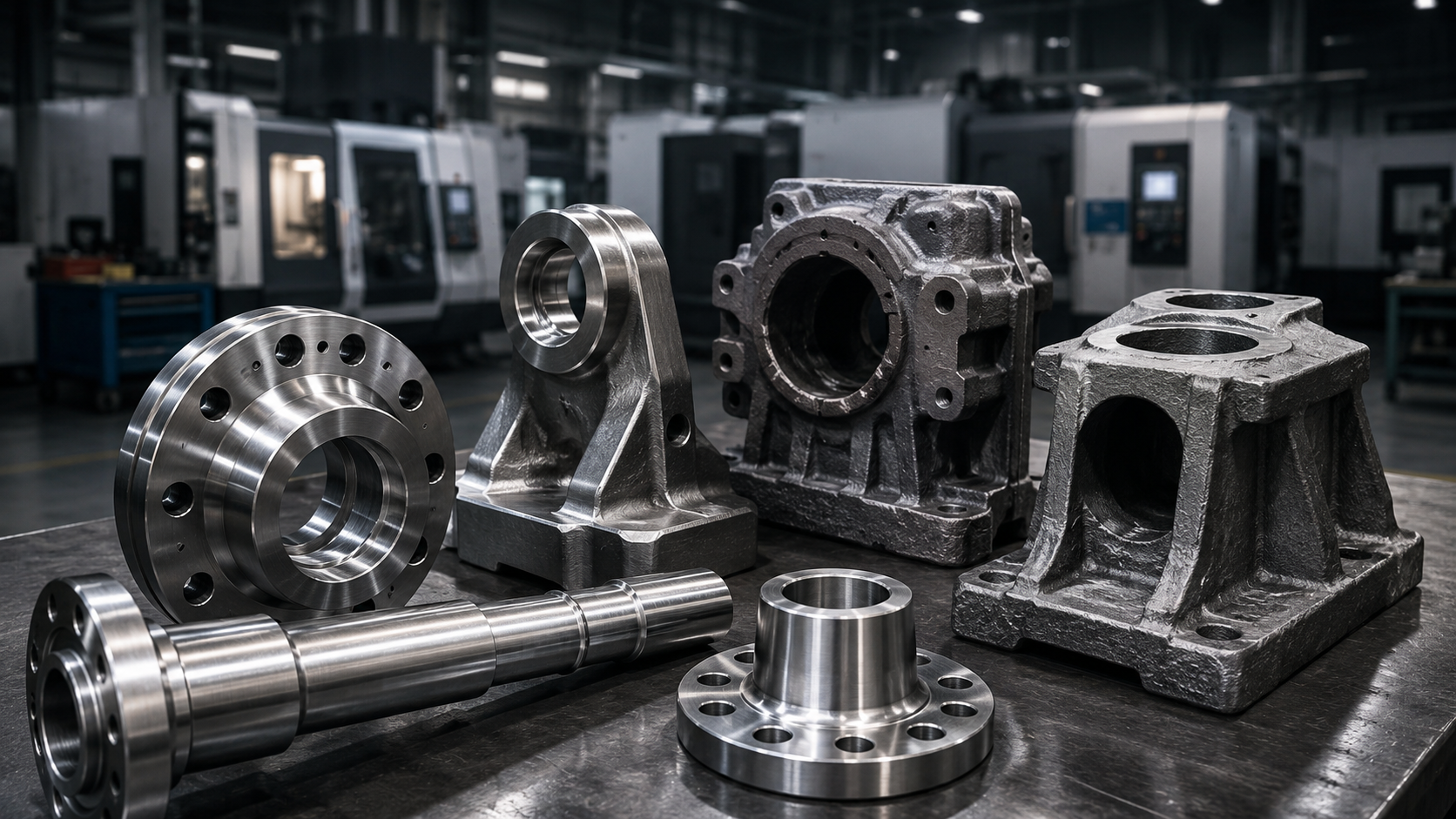
Table of Contents
1. The Foundation: Understanding the Blank That Shapes Everything
2. Market Landscape: The Scale of Cast and Forged Manufacturing
3. Machining Castings: Compensating for Inherent Variability
-3.1 Surface Challenges and Stock Allowance
-3.2 Tooling Strategy for Cast Materials
-3.3 Critical Quality Control for Cast Components
4. Machining Forgings: Leveraging Superior Material Integrity
-4.1 Higher Forces, Higher Precision
-4.2 Grain Flow and Its Machining Implications
-4.3 The Advantage of Predictability
5. Comparative Framework: Casting vs. Forging Machining Parameters
6. Selecting the Right Manufacturing Path
7. Partnering with Expert High-Precision Component Machining Specialists
Anyone who has spent time on a shop floor knows this truth: the machining strategy for a part is largely dictated by how that part came into existence. A cast blank and a forged blank of the same nominal alloy are fundamentally different animals. Treat them the same, and you're either scrapping parts or burning through tooling budget.
The global manufacturing landscape reflects just how central these processes remain. The steel casting market alone is projected to climb from USD 38.99 billion in 2025 to USD 66.80 billion by 2035, registering a CAGR of 5.53%. Meanwhile, the forging sector is estimated at USD 95.74 billion in 2026, expected to reach USD 161.15 billion by 2035 at a 5.3% CAGR. These aren't niche processes—they're the backbone of heavy industry.
This article unpacks the distinct machining approaches required for casting machining versus forging machining. We'll examine the specific technical considerations that separate successful high-precision blank machining from costly trial-and-error.
The Foundation: Understanding the Blank That Shapes Everything
Before a cutting tool ever touches the workpiece, the blank has already made a series of promises—some kept, some broken. The quality of the blank—whether cast or forged—directly determines machining parameters, tool life, and final part integrity. You can't machine your way out of a fundamentally flawed blank.
Casting is liquid forming. Metal is melted, poured into a mold, and allowed to solidify. This process excels at producing complex geometries and internal cavities, often with near-net shape capability that minimizes machining time. The trade-off? The solidification process inevitably introduces variability. Cast blanks typically exhibit coarser grain structures and are prone to internal defects such as porosity, shrinkage cavities, and inclusions.
Forging, by contrast, is solid-state shaping. Metal is heated to a plastic state and formed under compressive force—hammered or pressed into shape. This mechanical working refines the grain structure, eliminates internal voids, and produces a denser, more uniform material. The result is superior mechanical properties, but also a blank that behaves very differently under the cutting tool.
Market Landscape: The Scale of Cast and Forged Manufacturing
The sheer scale of casting and forging operations worldwide underscores why machining these materials efficiently matters at a macroeconomic level. The global castings market was valued at approximately RMB 468 billion in 2024, with a projected CAGR of 3.6% from 2025 to 2030. Steel castings specifically represented USD 77.06 billion in 2025, driven heavily by construction and infrastructure demand.
Forging, while smaller in overall volume, commands higher value per ton due to its superior material properties. The global forging market is projected to grow from USD 103.88 billion in 2026 to USD 163.04 billion by 2035, with a CAGR of 5.2%. Automotive applications dominate, accounting for 38% of global forging demand, followed by aerospace at 25% and general industrial machinery at 17%.
Machining Castings: Compensating for Inherent Variability
Machining cast components requires a different mindset than machining wrought or forged stock. You're not just removing material—you're navigating around potential internal discontinuities that formed during solidification.
Surface Challenges and Stock Allowance
Cast surfaces present several machining challenges. The outer skin of a casting often contains silica inclusions from the mold material, embedded sand, and a hardened layer from rapid cooling at the mold interface. This "casting skin" is abrasive and can dramatically accelerate tool wear if not properly accounted for in the toolpath strategy.
Stock allowance is another critical variable. Because castings can exhibit dimensional variation from pattern wear, mold shift, and solidification shrinkage, blank machining operations must typically leave more material for finishing than would be required for a forged or bar-stock equivalent. Insufficient stock risks leaving surface defects in the finished part; excessive stock wastes machine time and tooling.
Tooling Strategy for Cast Materials
The presence of hard inclusions and potential internal porosity demands specific tooling approaches for casting machining. Positive rake angle inserts with tough carbide substrates perform better than harder, more brittle alternatives when facing the abrasive cast skin. The goal is to get under the skin quickly with a robust roughing pass, then switch to a finishing tool that won't be compromised by what remains.
Coolant strategy matters differently for castings, too. Porous cast materials can absorb cutting fluids, leading to staining or, in the case of water-based coolants, internal corrosion that manifests only after the part is in service. Many shops prefer to machine cast iron dry or with minimal mist lubrication.
Critical Quality Control for Cast Components
Given the potential for subsurface defects, inspection protocols for machined castings must go beyond dimensional verification. Non-destructive testing—particularly X-ray or CT inspection—is often specified for safety-critical components to verify that machining hasn't exposed or approached porosity that could compromise structural integrity.
Machining Forgings: Leveraging Superior Material Integrity
If machining castings is about managing risk, machining forging machining is about managing forces. Forged materials are denser, tougher, and more consistent—qualities that demand more from your equipment but reward you with predictable, high-quality results.
Higher Forces, Higher Precision
Forgings possess refined grain structures and eliminate the porosity inherent to castings, resulting in a material that requires higher cutting forces. This is not a drawback—it's simply physics. A denser material with continuous grain flow offers greater resistance to the cutting edge.
The flip side is that forgings hold dimensions beautifully. Because the material is homogeneous and free from internal voids, surface finishes are more consistent and tool deflection is more predictable. For high-precision component machining, this translates to tighter tolerances and better repeatability across production runs.
Grain Flow and Its Machining Implications
One of forging's most significant advantages is aligned grain flow. During forging, the metal's internal grain structure is reoriented to follow the contours of the part geometry. This provides exceptional fatigue resistance and impact strength—properties that are particularly critical for components like crankshafts, connecting rods, and landing gear fittings.
However, this grain flow also creates directional machining considerations. Cutting perpendicular to the grain flow requires different parameters than cutting parallel to it. Aggressive cuts across the grain can induce micro-tearing or surface stress that compromises the very properties forging was meant to provide.
The Advantage of Predictability
Perhaps the greatest advantage of forging machining is predictability. Without the "surprise" internal defects that plague castings, process planning becomes more reliable. Tool wear follows predictable curves. Scrap rates drop. And when a part is destined for a safety-critical application—an aircraft landing gear component, a high-pressure valve body—that predictability is not just economical, it's essential.
Forged products generally exhibit improved mechanical properties and higher ductility compared to cast products, with finer grain structure and superior tensile strength. This means that once you dial in the machining parameters, you can run with confidence.
Comparative Framework: Casting vs. Forging Machining Parameters
The table below summarizes the key machining differences between cast and forged workpieces of comparable material grades. This framework serves as a starting point for process engineers developing machining strategies.
Table 1: Comparative Machining Characteristics — Castings vs. Forgings
Parameter | Cast Components | Forged Components |
Material Uniformity | Variable; coarse grain structure with random orientation | Homogeneous; fine, oriented grain flow |
Internal Defects | Porosity, shrinkage cavities, inclusions possible | Minimal; mechanical working eliminates voids |
Cutting Force Required | Moderate; lower due to less dense structure | Higher; denser material resists cutting |
Tool Wear Mode | Abrasive wear from casting skin and inclusions | Gradual, predictable flank wear |
Surface Finish Achievable | Good; may require extra stock for defect clearance | Excellent; uniform material yields consistent finish |
Typical Stock Allowance | 2-5 mm (varies with casting size and process) | 1-3 mm (more predictable shrinkage) |
Dimensional Stability | Good after stress relief | Excellent; minimal internal stress |
Cost per Finished Part | Lower upfront, higher scrap risk | Higher upfront, lower lifecycle cost |
Data compiled from industry machining guidelines and material property references.
The choice between casting machining and forging machining ultimately comes down to application requirements. Castings remain the preferred route for complex geometries, large parts, and applications where cost sensitivity outweighs extreme performance demands. Forgings dominate where failure is not an option—aerospace structural components, high-pressure fittings, automotive drivetrain parts.
Selecting the Right Manufacturing Path
For procurement professionals and design engineers, the decision tree should consider several factors:
· Geometry Complexity: If the part features intricate internal passages or complex contours, casting is often the only practical starting point.
· Performance Requirements: For components subject to cyclic loading, impact, or high stress, forging provides the grain structure and fatigue resistance that castings cannot match.
· Production Volume: Casting typically offers lower per-unit costs at high volumes, while forging may require higher tooling investment but delivers superior part consistency.
· Machining Budget: The predictability of forgings can reduce machining scrap and rework costs, potentially offsetting higher blank pricing over the production run.
Partnering with Expert High-Precision Component Machining Specialists
The distinction between casting machining and forging machining is not merely academic—it directly impacts tooling costs, cycle times, scrap rates, and ultimately, part reliability. A well-equipped high-precision component machining specialist understands that castings and forgings each require a fundamentally different approach to workholding, toolpath strategy, and quality verification.
The global market for these processes continues to expand, with combined metal stamping, forging, and casting revenues projected to reach USD 220 billion by 2033. As industries demand ever-tighter tolerances and higher-performance components, the ability to expertly machine both cast and forged blanks becomes not just a service offering, but a strategic advantage.
Whether your application demands the complex geometries achievable through casting or the superior mechanical integrity delivered by forging, the path from blank to finished component requires expertise that spans material science, cutting tool technology, and precision metrology. That's the difference between simply removing metal—and manufacturing components that perform reliably for decades.
Table of Contents
1. The Foundation: Understanding the Blank That Shapes Everything
2. Market Landscape: The Scale of Cast and Forged Manufacturing
3. Machining Castings: Compensating for Inherent Variability
-3.1 Surface Challenges and Stock Allowance
-3.2 Tooling Strategy for Cast Materials
-3.3 Critical Quality Control for Cast Components
4. Machining Forgings: Leveraging Superior Material Integrity
4.1 Higher Forces, Higher Precision
-4.2 Grain Flow and Its Machining Implications
-4.3 The Advantage of Predictability
5. Comparative Framework: Casting vs. Forging Machining Parameters
6. Selecting the Right Manufacturing Path
7. Partnering with Expert High-Precision Component Machining Specialists
Anyone who has spent time on a shop floor knows this truth: the machining strategy for a part is largely dictated by how that part came into existence. A cast blank and a forged blank of the same nominal alloy are fundamentally different animals. Treat them the same, and you're either scrapping parts or burning through tooling budget.
The global manufacturing landscape reflects just how central these processes remain. The steel casting market alone is projected to climb from USD 38.99 billion in 2025 to USD 66.80 billion by 2035, registering a CAGR of 5.53%. Meanwhile, the forging sector is estimated at USD 95.74 billion in 2026, expected to reach USD 161.15 billion by 2035 at a 5.3% CAGR. These aren't niche processes—they're the backbone of heavy industry.
This article unpacks the distinct machining approaches required for casting machining versus forging machining. We'll examine the specific technical considerations that separate successful high-precision blank machining from costly trial-and-error.
The Foundation: Understanding the Blank That Shapes Everything
Before a cutting tool ever touches the workpiece, the blank has already made a series of promises—some kept, some broken. The quality of the blank—whether cast or forged—directly determines machining parameters, tool life, and final part integrity. You can't machine your way out of a fundamentally flawed blank.
Casting is liquid forming. Metal is melted, poured into a mold, and allowed to solidify. This process excels at producing complex geometries and internal cavities, often with near-net shape capability that minimizes machining time. The trade-off? The solidification process inevitably introduces variability. Cast blanks typically exhibit coarser grain structures and are prone to internal defects such as porosity, shrinkage cavities, and inclusions.
Forging, by contrast, is solid-state shaping. Metal is heated to a plastic state and formed under compressive force—hammered or pressed into shape. This mechanical working refines the grain structure, eliminates internal voids, and produces a denser, more uniform material. The result is superior mechanical properties, but also a blank that behaves very differently under the cutting tool.
Market Landscape: The Scale of Cast and Forged Manufacturing
The sheer scale of casting and forging operations worldwide underscores why machining these materials efficiently matters at a macroeconomic level. The global castings market was valued at approximately RMB 468 billion in 2024, with a projected CAGR of 3.6% from 2025 to 2030. Steel castings specifically represented USD 77.06 billion in 2025, driven heavily by construction and infrastructure demand.
Forging, while smaller in overall volume, commands higher value per ton due to its superior material properties. The global forging market is projected to grow from USD 103.88 billion in 2026 to USD 163.04 billion by 2035, with a CAGR of 5.2%. Automotive applications dominate, accounting for 38% of global forging demand, followed by aerospace at 25% and general industrial machinery at 17%.
Machining Castings: Compensating for Inherent Variability
Machining cast components requires a different mindset than machining wrought or forged stock. You're not just removing material—you're navigating around potential internal discontinuities that formed during solidification.
Surface Challenges and Stock Allowance
Cast surfaces present several machining challenges. The outer skin of a casting often contains silica inclusions from the mold material, embedded sand, and a hardened layer from rapid cooling at the mold interface. This "casting skin" is abrasive and can dramatically accelerate tool wear if not properly accounted for in the toolpath strategy.
Stock allowance is another critical variable. Because castings can exhibit dimensional variation from pattern wear, mold shift, and solidification shrinkage, blank machining operations must typically leave more material for finishing than would be required for a forged or bar-stock equivalent. Insufficient stock risks leaving surface defects in the finished part; excessive stock wastes machine time and tooling.
Tooling Strategy for Cast Materials
The presence of hard inclusions and potential internal porosity demands specific tooling approaches for casting machining. Positive rake angle inserts with tough carbide substrates perform better than harder, more brittle alternatives when facing the abrasive cast skin. The goal is to get under the skin quickly with a robust roughing pass, then switch to a finishing tool that won't be compromised by what remains.
Coolant strategy matters differently for castings, too. Porous cast materials can absorb cutting fluids, leading to staining or, in the case of water-based coolants, internal corrosion that manifests only after the part is in service. Many shops prefer to machine cast iron dry or with minimal mist lubrication.
Critical Quality Control for Cast Components
Given the potential for subsurface defects, inspection protocols for machined castings must go beyond dimensional verification. Non-destructive testing—particularly X-ray or CT inspection—is often specified for safety-critical components to verify that machining hasn't exposed or approached porosity that could compromise structural integrity.
Machining Forgings: Leveraging Superior Material Integrity
If machining castings is about managing risk, machining forging machining is about managing forces. Forged materials are denser, tougher, and more consistent—qualities that demand more from your equipment but reward you with predictable, high-quality results.
Higher Forces, Higher Precision
Forgings possess refined grain structures and eliminate the porosity inherent to castings, resulting in a material that requires higher cutting forces. This is not a drawback—it's simply physics. A denser material with continuous grain flow offers greater resistance to the cutting edge.
The flip side is that forgings hold dimensions beautifully. Because the material is homogeneous and free from internal voids, surface finishes are more consistent and tool deflection is more predictable. For high-precision component machining, this translates to tighter tolerances and better repeatability across production runs.
Grain Flow and Its Machining Implications
One of forging's most significant advantages is aligned grain flow. During forging, the metal's internal grain structure is reoriented to follow the contours of the part geometry. This provides exceptional fatigue resistance and impact strength—properties that are particularly critical for components like crankshafts, connecting rods, and landing gear fittings.
However, this grain flow also creates directional machining considerations. Cutting perpendicular to the grain flow requires different parameters than cutting parallel to it. Aggressive cuts across the grain can induce micro-tearing or surface stress that compromises the very properties forging was meant to provide.
The Advantage of Predictability
Perhaps the greatest advantage of forging machining is predictability. Without the "surprise" internal defects that plague castings, process planning becomes more reliable. Tool wear follows predictable curves. Scrap rates drop. And when a part is destined for a safety-critical application—an aircraft landing gear component, a high-pressure valve body—that predictability is not just economical, it's essential.
Forged products generally exhibit improved mechanical properties and higher ductility compared to cast products, with finer grain structure and superior tensile strength. This means that once you dial in the machining parameters, you can run with confidence.
Comparative Framework: Casting vs. Forging Machining Parameters
The table below summarizes the key machining differences between cast and forged workpieces of comparable material grades. This framework serves as a starting point for process engineers developing machining strategies.
Table 1: Comparative Machining Characteristics — Castings vs. Forgings
Parameter | Cast Components | Forged Components |
Material Uniformity | Variable; coarse grain structure with random orientation | Homogeneous; fine, oriented grain flow |
Internal Defects | Porosity, shrinkage cavities, inclusions possible | Minimal; mechanical working eliminates voids |
Cutting Force Required | Moderate; lower due to less dense structure | Higher; denser material resists cutting |
Tool Wear Mode | Abrasive wear from casting skin and inclusions | Gradual, predictable flank wear |
Surface Finish Achievable | Good; may require extra stock for defect clearance | Excellent; uniform material yields consistent finish |
Typical Stock Allowance | 2-5 mm (varies with casting size and process) | 1-3 mm (more predictable shrinkage) |
Dimensional Stability | Good after stress relief | Excellent; minimal internal stress |
Cost per Finished Part | Lower upfront, higher scrap risk | Higher upfront, lower lifecycle cost |
Data compiled from industry machining guidelines and material property references.
The choice between casting machining and forging machining ultimately comes down to application requirements. Castings remain the preferred route for complex geometries, large parts, and applications where cost sensitivity outweighs extreme performance demands. Forgings dominate where failure is not an option—aerospace structural components, high-pressure fittings, automotive drivetrain parts.
Selecting the Right Manufacturing Path
For procurement professionals and design engineers, the decision tree should consider several factors:
· Geometry Complexity: If the part features intricate internal passages or complex contours, casting is often the only practical starting point.
· Performance Requirements: For components subject to cyclic loading, impact, or high stress, forging provides the grain structure and fatigue resistance that castings cannot match.
· Production Volume: Casting typically offers lower per-unit costs at high volumes, while forging may require higher tooling investment but delivers superior part consistency.
· Machining Budget: The predictability of forgings can reduce machining scrap and rework costs, potentially offsetting higher blank pricing over the production run.
Partnering with Expert High-Precision Component Machining Specialists
The distinction between casting machining and forging machining is not merely academic—it directly impacts tooling costs, cycle times, scrap rates, and ultimately, part reliability. A well-equipped high-precision component machining specialist understands that castings and forgings each require a fundamentally different approach to workholding, toolpath strategy, and quality verification.
The global market for these processes continues to expand, with combined metal stamping, forging, and casting revenues projected to reach USD 220 billion by 2033. As industries demand ever-tighter tolerances and higher-performance components, the ability to expertly machine both cast and forged blanks becomes not just a service offering, but a strategic advantage.
Whether your application demands the complex geometries achievable through casting or the superior mechanical integrity delivered by forging, the path from blank to finished component requires expertise that spans material science, cutting tool technology, and precision metrology. That's the difference between simply removing metal—and manufacturing components that perform reliably for decades.